


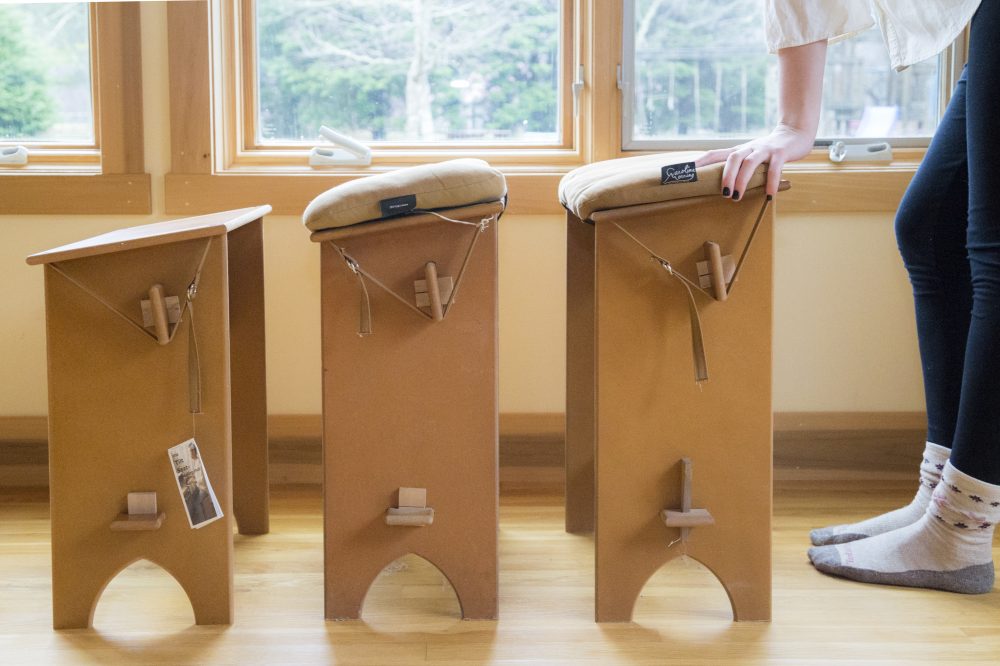
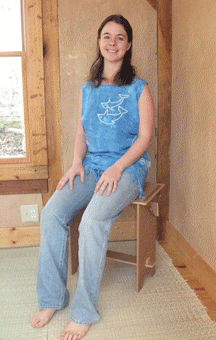

Why You Will Love It!
-
Aligns the spine into it’s natural S shaped curve position which is called ‘spine neutral’
-
Helps to alleviate back pain caused by sitting
-
Decompresses the vertebral lumbar disks
-
Stimulates metabolism by burning calories
-
Increases oxygen to the lungs by opening up the breathing channels
- Comes apart in 5 pieces for easy traveling
How It Works
- Kneeling and perching chairs open up the angle between the thigh and the torso, making it easier to retain the natural curvature of the spine
- This posture changes the stress distribution of the human body in comparison with the sitting position of an ordinary chair
- Because the angle of the hip joint is between that of sitting and standing, it allows the spine to be in a more “neutral,” or middle-of-range, position
- Because the knees are lower than the pelvis, the normal curve is restored to the lower spine, which reduces stress to the lower lumbar vertebrae
What It's Made Of
- Environmentally friendly, Forest Stewardship Council certified composit material called Medex. This is a non-toxic, 100% recycled content, wood fiberboard that uses wood scraps which would otherwise be discarded
- Non-toxic, whey based finish protects and gives a dark honey sheen
- Optional padded bench cushion available
- Weighs 10 pounds
- Supports up to 300 pounds
What Our Customers Are Saying
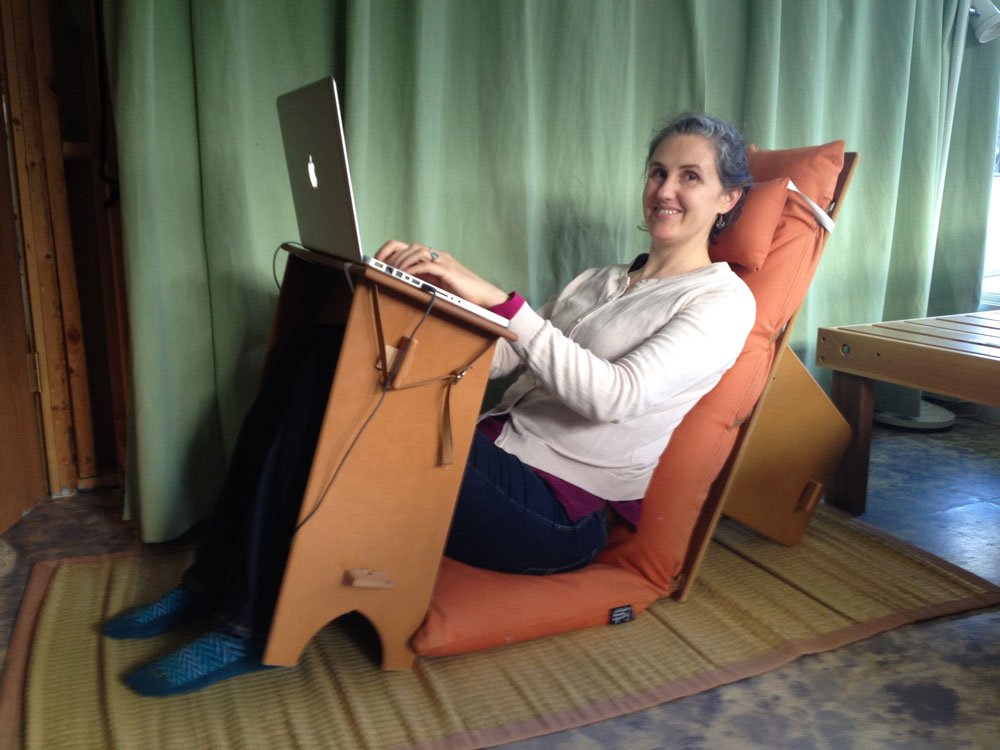
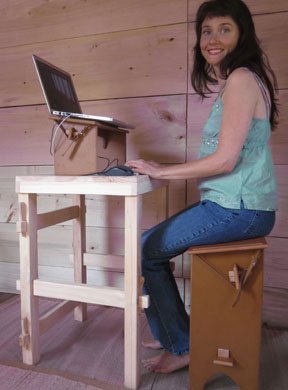
I use the “Tilt Seat” as my desk top for my laptop while sitting on the bench. I spend hours writing every morning this way. I alternate my legs – sometimes cross legged, sometimes spread out to the side of the desk, and sometimes under the bench. I can’t imagine ever going back to a normal desk again.
Why should you use this bench? Here’s why!
The tilted bench (similar to a Swiss kneeling chair) allows your pelvis to be tilted so your posture is very upright: no shoulders rolled forward or neck/head jutting out over your shoulders creating tightness in the neck muscles. Of course, you certainly can forget and end up collapsing your abs and allowing your pelvis to tilt back. Not a good idea as the entire reason for sitting this way is to improve your posture.
I had lived with chronic back pain for twenty-five years. This pain has awakened me every single night since its inception when I was nineteen years old. I am now forty-four.
I have used inversion tables, physical therapy, stretching (which I still do), yoga (which I still do), special exercises (which I still do), hypnosis for pain, a variety of chiropractors and massage therapists, and even seening accredited “healers” in hopes of getting something more than slight transient relief of this chronic pain.
Within two hours of my first usage of the tilt chair and peace bench, I noticed a gradual relieving of the constant strained feeling in my lower back! By the time the first two hours were up, I reported 80% to 90% relief of all back pain and soreness, shoulder stiffness and soreness, and 80% relief of neck soreness, aching and stiffness.
I then tried a few gentle stretches, and my range of motion was increased! That night, after using the tilt chair and having my peace bench on my desk to hold my computer keyboard, I slept FOR THE FIRST ENTIRE NIGHT WITHOUT PAIN SINCE I WAS NINETEEN! I am amazed.
I am so grateful to Carolina Morning and Patrick (the designer) for these wonderful items. They are not advertised as miracle furnishings, but to me they are. I never expected anything like this. I have had no recurring back or neck pain since using the tilt chair and peace bench! I meditate with greater ease using the peace bench. My posture has improved. I feel much more energy! Feelings of fatigue and tension have dropped tremendously, since I don’t wake up in pain and discomfort anymore! I am done with putting chiropractor’s kids through graduate school, and I am tired of making mortgage payments for every so-called “healer” who has claimed they could help my back. I plan to be buried with my tilt chair and peace bench, cause I’m taking them with me forever! With my eternal gratitude,
Until two weeks ago I did all of my studying at the library. Then I bought something I’ve wanted for years, a desk. It’s very small, ergonomic and it can double as a meditation stool, if you don’t meditate it will still straighten your back. This is the first time I’ve used this desk style. I am impressed; my wrists don’t get sore and you are forced to sit upright which will hold off fatigue. I can already feel a surge in my creativity.